 serin labs
Sensibo vs Cielo: Compared by Someone Who Sells Neither (2026)
Search "sensibo vs cielo" and read the first page of results carefully. Several of the most confident-sounding comparisons are published by companies selling a third smart AC controller. The verdict is written before the testing starts.
My bias is different, and it belongs in the first paragraph so you can weigh everything after it. I sell a wired control board for Mitsubishi heat pumps. I sell no infrared controller of any kind, I make nothing whichever of these you pick, and for a lot of people reading this, one of them is the right buy and my product isn't.
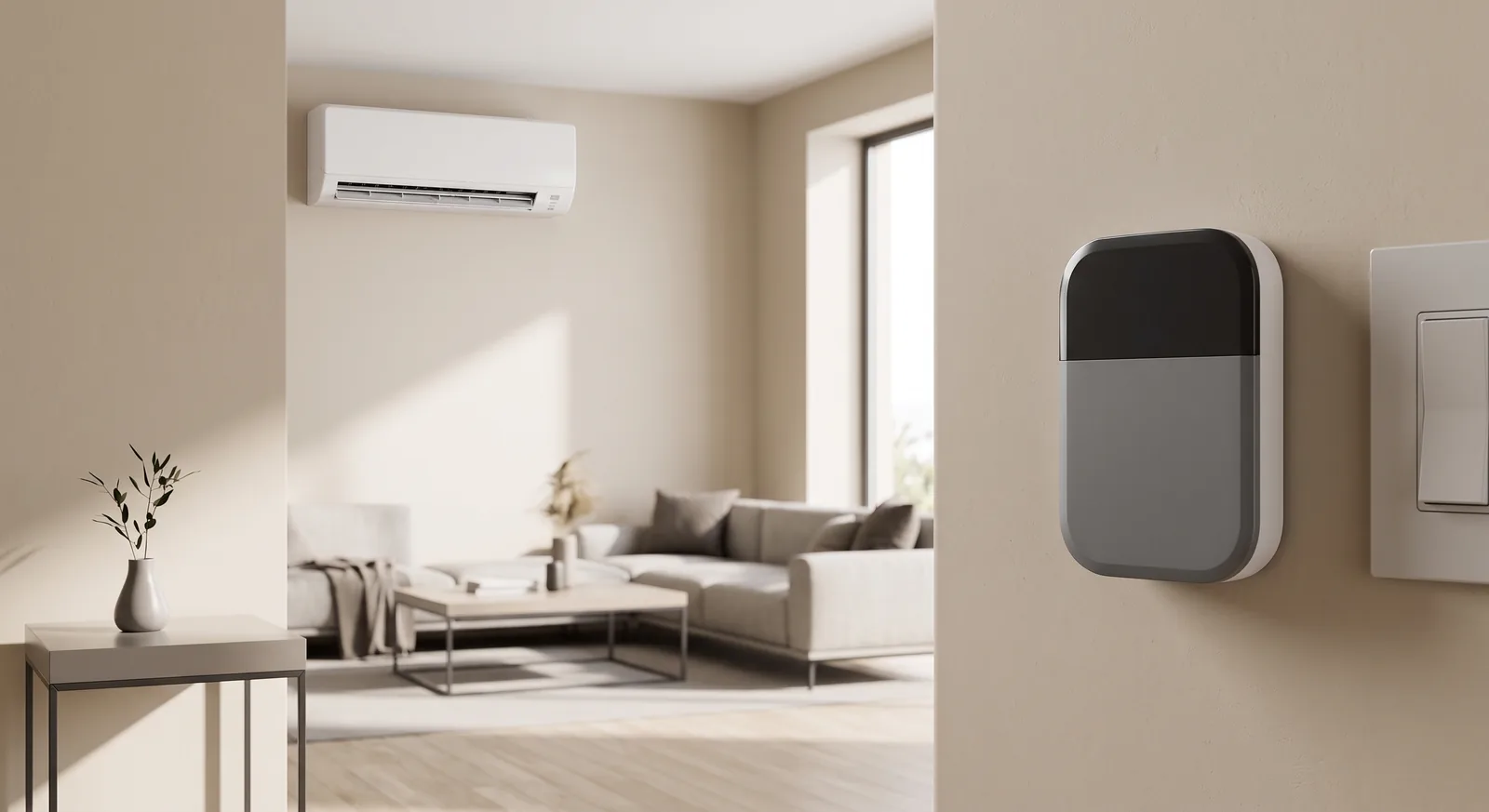
So here's the straight score, pulled from Sensibo's and Cielo's own pages at publication, September 2026.
Quick Facts: Sensibo vs Cielo
- Sensibo sells three AC controllers: Sensibo Sky ($89), Sensibo Air ($109), Sensibo Air Pro ($139), per Sensibo's store, September 2026.
- Cielo sells four consumer Breez models: Lite, Eco, Plus, and Max, plus a pro-channel Breez Edge Pro sold only through HVAC distribution.
- No Sensibo model has a screen. Every Cielo Breez model has one — full-colour touchscreen on the Max, segment LCD on Lite, Eco, and Plus.
- Apple HomeKit is gated per model, on one side only. Sensibo Air and Air Pro support HomeKit; Sensibo states plainly that the Sky does not. No Cielo model lists HomeKit — Cielo lists Siri Shortcuts, which is not the same thing.
- Subscriptions split the vendors cleanly. Sensibo's Energy Saver plan runs $2.49/month or $30/year. Cielo markets "Free App, No Subscription" across the Breez line.
- Home Assistant supports both, cloud-only. It classifies the Sensibo and Cielo Home integrations alike as Cloud Polling. Neither has a local path.
- Both are infrared, so neither can read the unit's real state. That limit is identical across every model and price here.
Why Nobody Neutral Writes This Comparison
The economics explain the SERP. A comparison between two competitors is cheap content for a third: write it once, score both rivals against a rubric you chose, and your product wins a category you defined. It isn't fraud. It's marketing wearing a lab coat.
So the two useful questions rarely get answered. Which is better for the way you live, and where does each flatly beat the other? Both have clean answers, one-sided enough that hedging would be dishonest.
The Two Lineups, as of September 2026
Sensibo keeps it simple: three controllers, same shape, all screenless, separated by sensors and ecosystem support. The step from Sky to Air buys Apple HomeKit; the step to Air Pro buys air-quality sensing — Sensibo's spec sheet lists TVOC detection with a CO₂-equivalent figure derived from it. All three carry a temperature and humidity sensor plus a universal IR receiver, which is how they learn your remote's codes. A Room Sensor ($79) and Window/Door Sensor ($49) sell alongside them.
Cielo's Breez line is broader and organised around the screen. The Breez Lite and Breez Eco sit at the bottom with a segment LCD; the Breez Plus puts temperature and humidity sensors behind the same style of display; the Breez Max tops the consumer range with a full-colour touchscreen and app-calibratable temperature and humidity sensors. A fifth model, the Breez Edge Pro, is marked "Exclusively for Pros" and ordered through HVAC distribution — not something you can go buy this afternoon.
One correction if you've read my earlier thermostat roundup: I called the Lite and Eco display-less there. Cielo's current pages list a "Sharp LCD segment display" on both. The newer vendor page wins.
Cielo makes price comparison harder than it should be: it publishes no prices on its own product pages. Every "Buy now" routes to Amazon, where the number floats. Cielo's Breez Max announcement quotes "a starting price of only $124.99," but that post was last updated May 2025 — a reference point, not today's checkout total. Sensibo prints its prices directly.
| Model | Price | Screen | Onboard sensors | Apple HomeKit | Home Assistant | Subscription |
|---|---|---|---|---|---|---|
| Sensibo Sky | $89 | None | Temp, humidity | No — stated outright | Cloud polling | $30/yr optional |
| Sensibo Air | $109 | None | Temp, humidity | Yes | Cloud polling | $30/yr optional |
| Sensibo Air Pro | $139 | None | Temp, humidity, TVOC + CO₂e | Yes | Cloud polling | $30/yr optional |
| Cielo Breez Lite | Unpublished (~$79 per my July 2026 roundup) | Segment LCD | Humidity, proximity | No | Not listed | None |
| Cielo Breez Eco | Unpublished | Segment LCD | Temperature | No | Not listed | None |
| Cielo Breez Plus | Unpublished | Segment LCD | Temp, humidity | No | Listed | None |
| Cielo Breez Max | $124.99 start (Cielo, May 2025) | Full-colour touchscreen | Temp, humidity | No | Listed | None |
Cielo Wins the Wall, Outright
This is not close, and deserves saying without qualification: if you want to walk up and touch a control, buy Cielo.
Every consumer Breez model has a display. Not one Sensibo does. A Sensibo is a small white square operated entirely by phone or voice, and no upgrade within the range changes that — $139 on the Air Pro buys air-quality sensing, not a screen.
That matters more than spec sheets suggest. A screen is what lets a guest change the temperature, what works when your phone is charging in another room, and what a household member with no interest in your smart home hobby will actually use. The Breez Lite even lights its screen on proximity when someone walks up.
If your household contains anyone who'd be annoyed by "just use the app," that settles it.
Sensibo Wins Apple Home — on Two of Three Models
Equally one-sided in the other direction: if you run an Apple household and want your AC in the Home app, buy Sensibo — and buy the Air or the Air Pro specifically.
Sensibo's product pages say the Air and Air Pro "integrate seamlessly with Apple HomeKit." The Sky's page says the opposite in as many words: "Sensibo Sky does not support Apple Homekit." That $20 step from Sky to Air is the entire HomeKit decision, and the easiest way to buy the wrong box in this category. Check the model, not the brand.
Cielo has no HomeKit at all. Across Lite, Eco, Plus, and Max the compatibility line reads "Alexa, Google Assistant, Siri Shortcuts, SmartThings, IFTTT" — Siri Shortcuts on every model, HomeKit on none.
That distinction matters, because vendors lean on the word "Siri" to blur it. Shortcuts triggers an action from a spoken phrase. HomeKit puts the device in the Home app as a real accessory — in the tile grid, usable in Home automations, on every family member's phone. If you only wanted voice commands, Shortcuts covers it. If you wanted it sitting in Apple Home alongside your lights, Cielo doesn't do that. (What native Apple Home control looks like on a Mitsubishi, separately.)
Alexa, Google Assistant, SmartThings, and IFTTT are a wash — both list all four across their ranges.
Subscriptions and Prices: Opposite Philosophies
Sensibo runs a freemium model. The core app — control, schedules, geofencing — is free, and the Energy Saver plan (branded Sensibo Plus) costs $2.49/month or $30/year, off a $60 list. What it gates is a real list: energy statistics, Sensibo's Optimus optimisation, Anti-Mold, AC Health Check, an AI assistant, Auto-Off failsafe timers, open-window detection, and an extended 12-month warranty on one device. No commitment, cancel any time.
Cielo takes the other road and markets it hard: "Free App, No Subscription" appears in its product titles and across its pages. There is no paid Cielo tier for the Breez line.
That $30/year compounds. Over five years a $109 Sensibo Air with the plan runs about $259; a Breez Max at its stated $124.99 start stays $124.99. If you'd never touch energy statistics, Sensibo's free tier is fine. If those features are what drew you in, price them as a recurring line, not a footnote.
Home Assistant: Two Cloud Integrations, No Local Path
Both vendors have official Home Assistant support; both are cloud-dependent. Home Assistant's own docs classify each integration's IoT class as "Cloud Polling."
The Sensibo integration polls the Sensibo API once per minute and needs an API key from your dashboard. The docs are blunt about the dependency: "This service is reliant on an internet connection and that the Sensibo API is available."
Cielo's is newer. The Cielo Home integration arrived in Home Assistant 2026.6 with a Bronze quality rating, provides climate and sensor entities, and talks to Cielo's cloud API. Becoming a core integration at all counts in Cielo's favour over community-only support — but changes nothing about the dependency.
One caveat — the per-model gating problem again: Cielo lists Home Assistant on the Breez Max and Plus pages, but not on the Eco or Lite. From outside I can't tell whether that's a real difference or a stale page. If Home Assistant is why you're buying, buy the model that names it and verify before the return window closes.
Either way, Home Assistant is not reading your air conditioner. It's reading a vendor's cloud copy over the internet. If your internet is out, or the vendor's API is having a day, your automations are too.
What Neither One Can Do
Everything above differs. Here's what doesn't, and it applies identically to an $89 Sky and a $124.99 Breez Max.
Both require a vendor cloud account. No local-only mode on either side. You're choosing whose servers your air conditioner depends on, not whether it depends on any.
Both are blind to what your unit is doing. Infrared is one-way, so the state your app shows is a model maintained from the last command sent rather than a reading — I've covered that mechanism, the frame format behind it, and the three ways it drifts in a dedicated post.
The practical cost: no compressor frequency, no outside air temperature, no runtime, no error codes. If your heat pump faults at 2 a.m. and shuts down, neither app will tell you. Both keep reporting the last thing they said.
In fairness, both close a loop that matters. They measure the room and drive the unit toward your setpoint — a better signal than the indoor unit's own sensor reading return air at the ceiling. For most households, that's the loop they wanted.
The Third Option, and Only If You Own a Mitsubishi
Late, because it's narrow and won't apply to most people reading this.
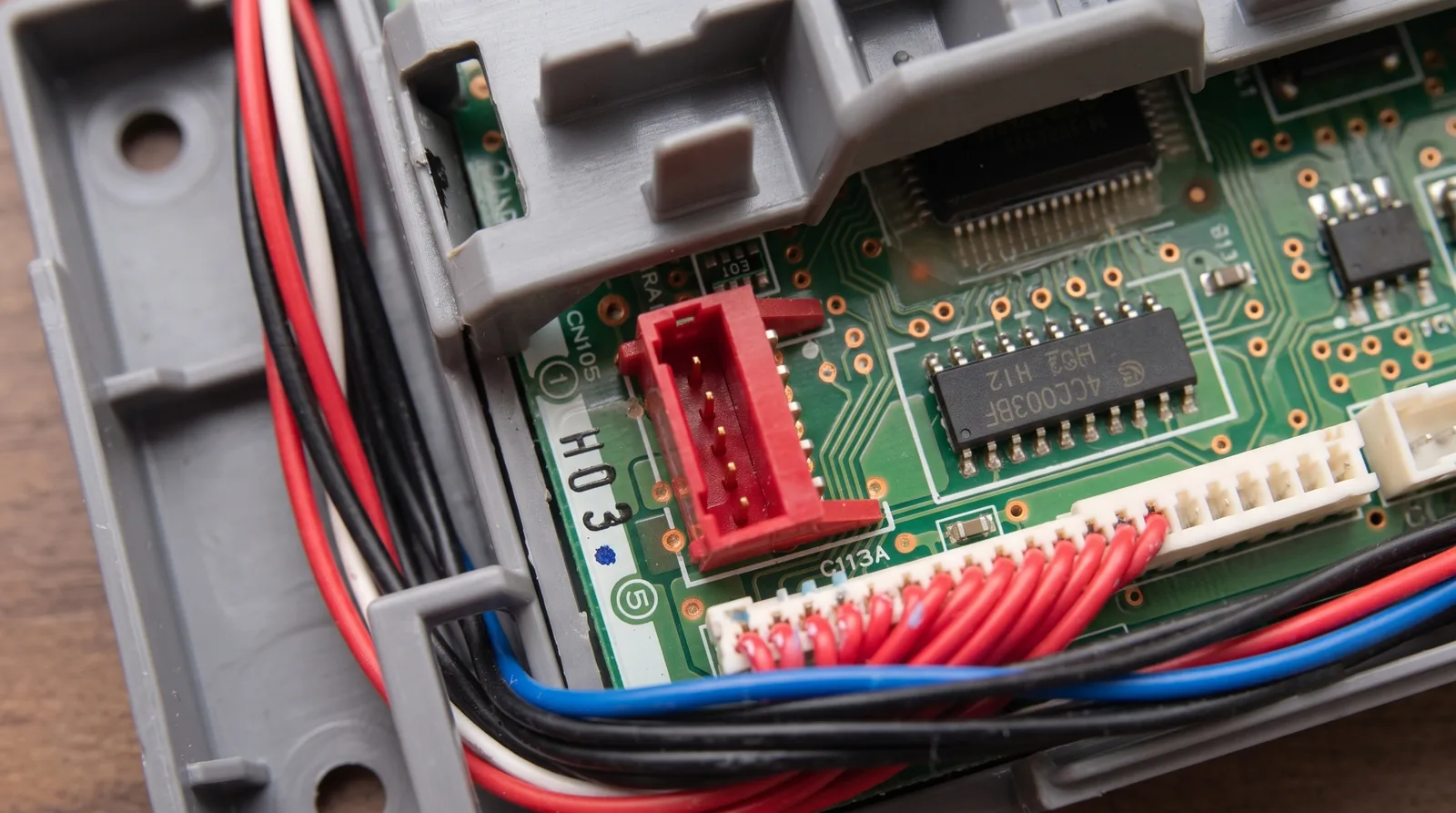
Mitsubishi indoor units have a service port called CN105 — the same one Mitsubishi's own Wi-Fi adapter and wall controllers use. It's a two-way serial connection, so a board on that port can ask the unit what it's doing and get an answer: real settings, compressor frequency, outside air temperature, runtime, error codes. That's what I sell: a small ESP32 board, $35 pre-assembled or $15–20 in parts, that you flash yourself from a browser with either of two free, open-source firmwares — ESPHome for Home Assistant, or an Apple Home compatible build for Siri. Both fully local, no account, no fees.
The constraints, because they disqualify plenty of people: Mitsubishi only — no Daikin, no Fujitsu, no LG. You open the indoor unit once to plug it in, which if you rent is a landlord conversation you don't want. No screen on the wall. Some units have the connector fitted but not wired for control, and if yours is one of those, IR is your answer too. On a multi-head system it's one board per indoor unit, which changes the arithmetic against a single Sensibo covering a room.
Weighing all four categories rather than these two? The full comparison is the better starting point.
Who Should Buy Which
- You want a screen someone can walk up and use. Cielo, and the Breez Max if budget allows — full-colour touchscreen, live temperature and humidity. The clearest verdict on this page.
- You're an Apple household and want it in the Home app. Sensibo Air ($109) or Air Pro ($139). Not the Sky — Sensibo says outright it has no HomeKit. Cielo gives Siri Shortcuts, not Home-app accessories.
- You hate subscriptions on principle. Cielo. No paid tier exists on the Breez line — a design decision, not an oversight.
- You want energy statistics, mould prevention, and optimisation. Sensibo, and budget the $30/year from day one.
- You want air-quality sensing in the same box. Sensibo Air Pro — TVOC with a derived CO₂-equivalent reading. No Cielo model lists it.
- You rent, won't open the unit, or run mixed brands. IR, full stop — the only category here that doesn't care what's on the badge. Pick by screen or ecosystem above and ignore my product.
- You own a Mitsubishi, you'll open the cover once, and you want the app right every time. CN105, not IR. Two-way is the only way to know rather than assume — and awkwardly for the vendors above, it's the cheapest option here.
The Short Version
These two aren't close competitors differing on details. They optimise for different people. Cielo builds a thermostat that also has an app. Sensibo builds an app that also has a sensor. Once you know which sentence describes what you wanted, the model number falls out of it.
If your answer landed on Mitsubishi and CN105 instead:
- Check that your unit has a usable CN105 port — five minutes, and it's the only hard requirement.
- Get the board and cable, one per indoor unit, or the pre-assembled controller at $35.
- Flash the firmware yourself from your browser — ESPHome for Home Assistant, or the Apple Home compatible build for Siri.
Both of these boxes are good at being a remote control that never leaves the room. Neither has ever heard your heat pump say a word back.
Prices, lineups, and ecosystem support verified against Sensibo's and Cielo's own pages, September 2026. This category churns tiers and gates HomeKit per model — confirm the model number before you buy.
Related
- Why IR controllers fall short on Mitsubishi
- The best smart thermostat for a mini-split
- Every smart-control option compared
- Check your unit for a CN105 port
Next step
Check your unit first
Type your indoor unit's model number for a verdict in under a minute. If it fits, the firmware flashes in the browser in about two minutes.