 serin labs
Is It Cheaper to Leave a Mini-Split On All Day?
Anyone who has lived with a furnace learned the same reflex: you're leaving, so turn it down. Then people install a mini-split and keep the reflex, and the argument starts. One of you switches it off on the way out; the other insists that makes the evening more expensive. Neither of you has a meter that settles it.
So I went looking for who had measured it. The reflex is roughly wrong for a workday and roughly right for a long absence, with the boundary near half a day. Every claim below is somebody else's published work, linked where it appears.
Quick Facts
- Short answer: for a workday absence, holding a steady setpoint on an inverter mini-split is usually cheaper than switching it off and recovering later. Past about 12 hours away, a setback wins.
- Why it differs from a furnace: an inverter modulates down instead of cycling off, and per EPRI's field-test report, "when operating at less-than-maximum capacity, the system efficiency tends to increase."
- How deep to set back, per BetterBuiltNW: under 6 hours, none; 6–12 hours, two to three degrees; over 12 hours, five to eight degrees.
- Switching fully off is right in mild shoulder weather when neither heating nor cooling is needed, per NEEP's homeowner guide — which says the opposite in very cold weather.
- Deep setbacks force recovery at full compressor speed, which BetterBuiltNW calls "the most inefficient full power mode."
- The "save 10% by setting back 7°–10°F" figure is Department of Energy guidance for conventional systems, quoted here by PNNL. Not a heat-pump number.
- Multi-zone is a special case: switching off individual indoor units can save nothing, or cost energy, if the remaining load drops below the outdoor unit's minimum capacity.
Why "On" Means Something Different on an Inverter
A single-speed heat pump has two states, and switching between them costs something. EPRI's field-test report: "inherent to this process is some cycling loss as the energy that was built up in pressurizing refrigerant dissipates."
Your Mitsubishi doesn't work that way. NEEP's cold-climate spec requires that the "compressor must be variable capacity," and PNNL's Building America Solution Center notes that on a ductless system "the inverter compressor allows the system to ramp down to as little as 10% of rated capacity."
EPRI again: "Only when the load on the building is lower than the minimum capacity the heat pump can provide does the system cycle. This reduces cycling losses overall."
Here's what inverts the furnace intuition: running slowly isn't merely less bad, it's more efficient. At reduced speed, EPRI says, the evaporator and condenser "become effectively 'over-sized' for the operating condition," which "allows more heat transfer per unit of refrigerant in the cycle, improving efficiency at part-load operation."
Oak Ridge National Laboratory found the same in a research home: variable capacity units gain from "increased operation at part load conditions that yield higher efficiencies than full-load operation" (ORNL/TM-2013/581, Munk et al., 2014). NEEP puts it to homeowners in one line: "Cold climate heat pumps are designed to run almost continuously, at a very low level. The lower the speed, the more efficient they are."
So Is It Cheaper to Leave a Mini-Split On All Day?
For the eight or nine hours you're at work, the guidance says yes — or close enough not to fuss over.
Efficiency Maine's user tips put it flatly: "Heat pumps operate most efficiently when holding a steady temperature. Turning heat pumps down when you're away or asleep may actually use more energy than leaving them on." And: "adjusting the temperature for short periods of time, such as overnight, will not save money with heat pumps."
NEEP's guide has a heading that just reads "Set it and Forget it," and under it: "Avoid frequently adjusting the thermostat; try to keep indoor settings steady." Then the warning that matters here — "unlike conventional heating systems, deep setbacks of cold-climate heat pumps may cost you energy and money." And: "Avoid turning heat pump unit(s) 'on' and 'off' to control the temperature." In summer too — "'Set it and forget it' is effective when air conditioning, too."
Now the other side, because it's real. A cooler house does lose heat more slowly, which is why setback works at all. DOE's rule of thumb, quoted by PNNL: "consumers can save as much as 10% per year on heating and cooling by simply turning the thermostat back 7°–10°F for eight hours a day from its normal setting." But that assumes a system whose efficiency is the same whenever it runs. An inverter's isn't. The question is whether the coasting saves more than the recovery costs — and over a workday, the sources say usually not.
What Recovery From a Deep Setback Costs
The penalty is concentrated in the hour after you come home.
BetterBuiltNW is blunt: recovery from a deep setback "causes the heat pump's efficiency to plummet," because "the system will run in the most inefficient full power mode to quickly recover a room or house back to the original setpoint." Ductless and variable capacity heat pumps, they note, "are far more efficient when running at low speed than at full power." EPRI agrees: when a unit over-speeds its compressor, "the overall efficiency of the heat pump is reduced by this."
Natural Resources Canada adds the timing problem. Their heat pump guidance: "heat pumps have a slower response than furnace systems, so they have more difficulty responding to deep temperature setbacks," and the unit "may not be able to supply all of the heat required to bring the temperature back up to the desired level on short notice. This may mean that the supplementary heating system operates until the heat pump 'catches up.'"
That last clause is where the biggest money goes — on systems that have supplementary heat. Hence PNNL's description of heat-pump thermostats built with "adaptive-recovery technology that directs the heat pump to minimize the use of costly auxiliary heating, which is typically electric resistance heat." Whether that applies to your unit is a question for your manual. What applies to every inverter is the first penalty: recovery runs where the unit is least efficient.
Defrost worsens the cold-weather version. In ORNL's instrumented homes — which had electric resistance backup — "the drop in the indoor temperature during the defrost cycle was often enough to trigger supplemental resistance heat when the heat pump switched back to the heating mode after the defrost cycle." Even without resistance heat, a unit already behind loses ground each time it stops heating to clear its outdoor coil. NEEP is unambiguous: "Don't shut your heat pump off in very cold weather! If anything, turn it up a bit."
Where the Guidance Disagrees, and What Nobody Can Tell You
I'd rather show you the seam than pretend it isn't there.
Natural Resources Canada does not say "never set back." It recommends "moderated setbacks of not more than 2°C," or a smart thermostat "that switches the system on early, in anticipation of a recovery from setback." And on the same page it argues in the other direction: "for variable speed systems, setbacks may allow the system to operate at a lower speed, reducing wear on the compressor and helping to increase system efficiency."
Read that against NEEP's "deep setbacks may cost you energy and money" and you have a real split. It resolves mostly on the word deep — NRCan's 2°C cap is shallow, and shallow is what a gentle recovery absorbs. But the claim that a setback can be efficiency-positive on a variable-speed system is NRCan's, not mine, and NRCan is no fringe source. NEEP leaves its own door open: "It's fine to adjust temperatures up and down as needed for comfort (e.g. turn it down at night if you like it a bit cooler)."
Three things nobody here can tell you:
- Your envelope. A tight house barely drifts in eight hours, so the setback you dial in isn't the setback you get. A leaky house drifts far, saves more while you're out, and pays more to climb back. Same setting, opposite conclusion.
- Your climate and season. Everything above shifts with outdoor temperature, and EPRI gives the reason: "as the temperature difference between indoor and outdoor increases, the efficiency of the cycle decreases." A January recovery in Vermont isn't an October one in Georgia.
- Your kilowatt-hours. None of these sources measured your house, and I won't hand you a percentage that pretends otherwise.
When You Should Actually Turn It Off
The exceptions are the useful half of the answer.
Mild shoulder season. NEEP is direct: "Set the unit to 'off' when outside temperature is mild and no heat or air conditioning is needed." In October and April, "on all day" mostly means chasing a setpoint the weather would have given you free.
Long absences. A weekend away isn't a setback question, it's a shutdown question. BetterBuiltNW's tiering hands it to a conventional setback.
Multi-zone, carefully. With several heads on one outdoor unit, shutting off the unused rooms feels thrifty. PNNL says the savings "can range from modest to negative. It can be negative energy savings if turning off indoor units causes the heating or cooling load to drop below the minimum capacity of the outdoor unit, causing it to cycle on and off." Shrink the load too far and you've rebuilt the on/off machine you paid extra to avoid — more on multi-zone control.
Not in a cold snap. The one that costs most when you get it wrong.
The Decision Rule, in Plain Language
BetterBuiltNW published the clearest version I found, written for ductless heat pumps and keyed to how long you're gone rather than the season:
| How long you're away | What to do | Source |
|---|---|---|
| Under 6 hours | No setback — hold the setpoint | BetterBuiltNW: "< 6 hours: No setback" |
| 6–12 hours (a workday) | Two to three degrees, no more | BetterBuiltNW: "6-12 hours: 2-3 degree setback" |
| More than 12 hours | Five to eight degrees | BetterBuiltNW: "12+ hours: 5-8 degree setback" |
| Days away, mild weather | Off | NEEP: off "when outside temperature is mild and no heat or air conditioning is needed" |
| Days away, cold weather | Setback, not off | NEEP: "Don't shut your heat pump off in very cold weather!" |
Two amendments. NRCan caps a routine daily setback at about 2°C (roughly 3–4°F), landing on BetterBuiltNW's workday tier. And if the setback is scheduled, both NRCan and PNNL want recovery started early and ramped gently, not demanded at 5 p.m. sharp.
If you remember one thing: the shorter the absence, the shallower the setback, and under six hours don't bother.
Making the Rule Automatic — and Checkable
A rule with tiers is the kind of thing nobody executes by hand for long, which is where a controller helps — a small part of the answer, not the answer.
The Serin controller is an ESP32 board that plugs into the CN105 service port already inside most Mitsubishi indoor units, and you flash one of two free open-source firmwares onto it yourself. Neither is ours; both are separate community projects, compared here.
On the ESPHome firmware the unit becomes a Home Assistant climate entity, so an early, gently-ramped setback is an automation instead of a habit. And the Apple Home firmware's diagnostics expose compressor frequency, outside temperature, runtime hours, and sub-mode state — whether your unit is loafing or grinding at full power. Every claim in this post is about compressor speed. You can watch yours.
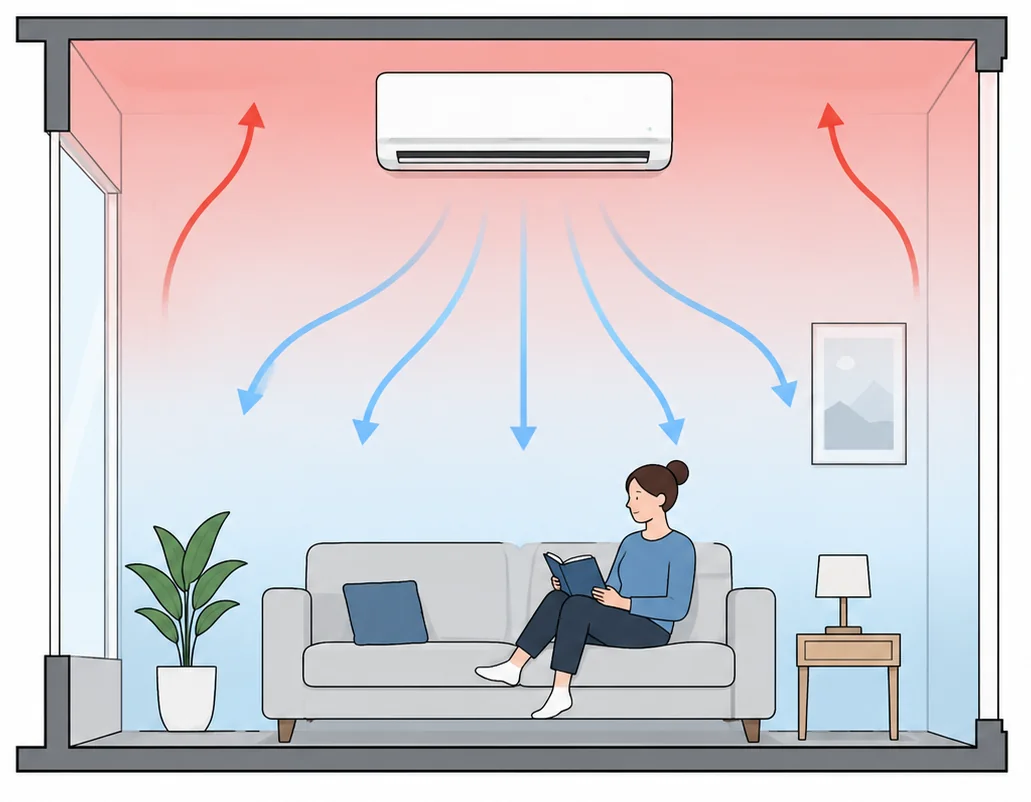
One caveat that undercuts the exercise if you skip it: a mini-split senses return air near the ceiling, so "holding 70" may not be holding 70 where you sit — why, and how to fix it.
If you'd rather not add hardware, the rule works fine typed into a handheld remote. It just requires you to be the automation.
The Short Version
- Out for the day. Leave it alone, or take it down two or three degrees. This is where the furnace reflex costs you.
- Gone longer, or on vacation. Set back five to eight degrees, and recover early rather than fast. Off only if the weather is mild.
- Multi-zone owner. Think twice before shutting individual heads off; below the outdoor unit's minimum, you've reintroduced cycling.
Three steps:
- Pick your tier from the table and set the schedule once, in whatever controls you already have.
- To enforce it automatically and watch the compressor behind it, check your unit for a CN105 port and read the controls comparison first.
- Make sure the setpoint you're holding refers to the air you sit in, not the air at the ceiling.
Your furnace rewarded you for fiddling with it. Your mini-split rewards you for leaving it alone — right up until you leave the house for more than half a day.
Related
- Every way to make a Mitsubishi mini-split smart
- Fix the wrong-temperature problem
- Set up the ESPHome firmware
- What the Apple Home firmware exposes
Next step
Check your unit first
Type your indoor unit's model number for a verdict in under a minute. If it fits, the firmware flashes in the browser in about two minutes.