 serin labs
Mitsubishi Model Numbers, Decoded: MSZ, MSY, GL, FS, FH, and the Letters That Matter
You've got the front flap open and a label staring back at you that reads something like MSZ-FH12NA. Seven characters, and every one of them means something. Search for what they mean and you'll find a dozen forum posts, each stated with total confidence, half of them contradicting each other.
Here's the thing: Mitsubishi publishes a model reference guide. Most of that string decodes cleanly from it. And the parts that don't decode are worth knowing too, because the letters people argue hardest about on forums are exactly the letters Mitsubishi never published a key for.
So this is the honest version. Sourced where I could source it, and explicitly blank where I couldn't.
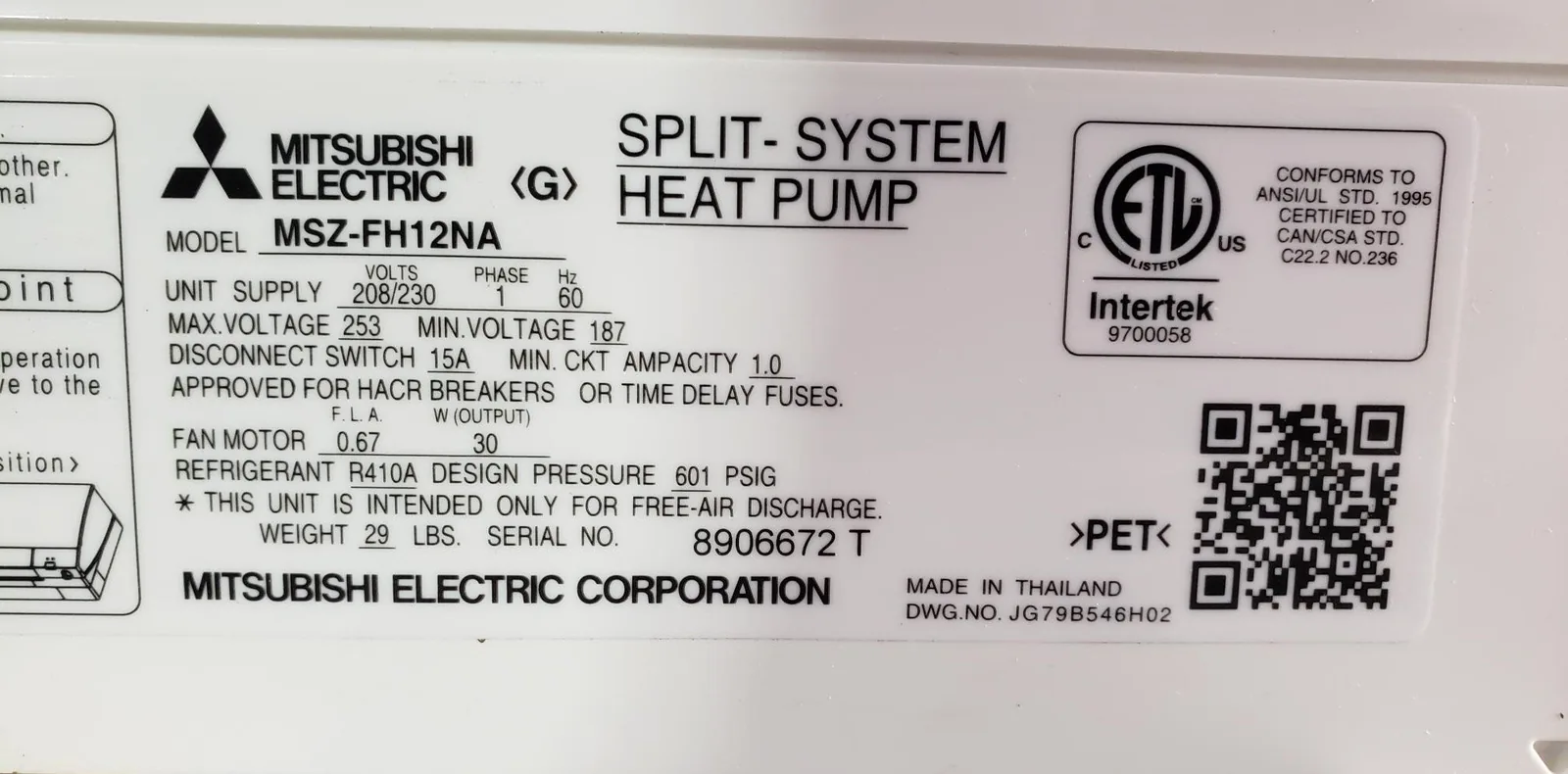
Quick Facts: Reading a Mitsubishi Model Number
- First letter, M or S: Mitsubishi's M-Series Model Reference Guide lists both as "Mini-split."
- Second letter is where it mounts:
Swall-mounted,Ehorizontal-ducted,Ffloor-mounted,Lceiling cassette,Vmulti-position air handler,Usingle-zone outdoor,Xmulti-zone outdoor. - Third letter is what it does:
Z= heat pump (inverter-driven),Y= cooling only (inverter-driven). MSZ heats and cools. MSY only cools. - The number is nominal capacity, BTU/H × 1,000. MSZ-FH12NA is rated 12,000 BTU/h cooling on its Mitsubishi submittal sheet. Nominal is a size class, not the rated figure — MSY-GL15NA is rated 14,000.
N= 208/230V,W= 115V. TheAthat usually follows is the control-method position.- The two-letter series code — FH, GL, FS, GS, EF — has no published key. Mitsubishi names the position and doesn't say what the letters stand for.
- The trailing suffix is what decides CN105 compatibility on several series. MSZ-FE09NA-8 has the port; MSZ-FE09NA doesn't.
What Each Position in a Mitsubishi Model Number Means
Mitsubishi Electric Trane HVAC publishes an M-Series Model Reference Guide in its M-Series catalog (pages 40–42; the copy I worked from is distributor-hosted). It's one annotated diagram, and it does most of the work.
The guide's worked example is an outdoor unit, MXZ-2C20NAHZ2-U, with twelve labelled fields. Applied to an indoor unit, MSZ-FH12NA falls out like this:
| Position | Mitsubishi's field name | In MSZ-FH12NA |
|---|---|---|
| 1 | Family | M — Mini-split |
| 2 | Type | S — Wall-mounted Indoor Unit |
| 3 | Cooling Only / Heat Pump | Z — Heat Pump (INVERTER-Driven) |
| 4–5 | System generation / series | FH — no published key |
| 6–7 | Capacity (Nominal) | 12 — BTU/H × 1,000 |
| 8 | System Voltage | N — 208/230V |
| 9 | Control Method | A — Control |
| trailing | Model Version, Service Reference Number | none on this model |
Two things stand out. The guide gives M and S the same definition — "Mini-split" — so the first letter tells you little on its own. And characters four and five, the two letters that name the series everybody shops by, sit in a position the guide labels but never enumerates.
That second point is the whole reason this post exists, so I'll come back to it.
MSZ vs MSY: The Letter That Decides Whether It Heats
This is the highest-stakes character in the string, and it's the third one.
The reference guide's Cooling Only / Heat Pump field is unambiguous: Z = Heat Pump (INVERTER-Driven), Y = Cooling Only (INVERTER-Driven). An MSZ-GL12NA is a heat pump. An MSY-GL12NA is the same wall-mounted body that only makes cold air. Same shape on the wall, same install, one of them useless in February.
The pattern holds across the range, which is the best evidence it's a rule rather than a coincidence. Outdoor units follow it: MUZ heats, MUY doesn't. Mitsubishi Electric Sales Canada's P-Series guide specification covers the light-commercial outdoor line as "PUZ/PUY" under a heading that reads "Heat Pump and Cooling Only." Same letters, same meaning, different product family.
For local control it changes nothing. Our compatibility data records MSY units as running the same control board as their MSZ equivalents, so the CN105 answer follows the series, not the Z-or-Y. MSY-GL and MSY-GS are fine. MSY-GE and MSY-D are suffix-dependent. MSY-A has no usable control port at all.
Where Does It Mount? The Second Letter
The Type field is the one that tells you what you're looking at without seeing the unit. Straight from the guide:
| Letter | Type | Prefixes you'll see |
|---|---|---|
S |
Wall-mounted indoor unit | MSZ, MSY |
E |
Horizontal-ducted indoor unit | SEZ |
F |
Floor-mounted unit | MFZ |
L |
Ceiling cassette indoor unit | MLZ, SLZ |
V |
Multi-position air handler | SVZ, MVZ |
U |
Single-zone outdoor unit | MUZ, MUY, SUZ |
X |
Multi-zone outdoor unit | MXZ |
Those last two rows matter more than they look. Second letter U or X means you're reading the outdoor unit, and it has no CN105 port for a controller. Go back to the indoor head. On a multi-zone system that's one label per head, not one for the whole system.
P-Series and City Multi use a different family letter but the same idea. The City Multi Indoor Unit Model Number Reference Guide (Mitsubishi Electric Trane HVAC US, SKU ME-50-1005-01, 2019) publishes the key: Model Family P = Packaged AC, then an Application letter — K Wall Mounted, L Ceiling Cassette (4-way), M Ceiling Cassette (1-way), C Ceiling Suspended, E Ceiling Concealed Ducted, F Floor Standing, V Multi-position Air Handler. So PEFY is P + E (concealed ducted) + FY (the guide's "Indoor Unit" code).
The P-Series guide spec confirms the same mapping by name for the Mr. Slim line: "PCA Ceiling Suspended Type, PEAD Ducted Type, PKA Wall Mounted Type, PLA Ceiling Cassette Type, PVA Ducted Air Handler."
What Do the Numbers in a Mitsubishi Model Number Mean?
Capacity, in thousands of BTU per hour. The reference guide states it plainly: "Capacity (Nominal) BTU/H (X 1,000)." So 09 is a nine, 12 a twelve, 18 an eighteen.
Nominal is doing real work in that sentence, and it's where a lot of spec-sheet arguments start. The word means size class, not measured output. Two examples from Mitsubishi's own tables:
- The MSZ-FH12NA submittal sheet (Mitsubishi Electric Sales Canada, doc SB_MSZ-FH12NA_&_MUZ-FH12NAH(-1)_201910) lists cooling rated at exactly 12,000 Btu/hr. The code matches.
- The M-Series catalog's own performance table lists MSY-GL15NA rated at 14,000 Btu/h and MSY-GL24NA at 22,500. The codes don't match, and they aren't meant to.
The P-Series numbers land on the nose more often. That guide spec's capacity table runs PUZ(Y)-A12 at 12,000, A18 at 18,000, A24 at 24,000, A30 at 30,000, A36 at 36,000, A42 at 42,000 Btu/h cooling.
Practical upshot: use the number to know roughly what size box you own. Use the submittal sheet if you need the actual figure.
GL, FS, FH, GS: The Letters Mitsubishi Never Decoded
Here's the part where most write-ups on this topic quietly start guessing.
The reference guide has a position for those two letters. It does not publish a table saying GL means one thing and FH another. I checked the M-Series catalog, the P-Series guide spec, a submittal sheet and the City Multi nomenclature guide. None decodes a series code letter by letter. So I won't tell you that G stands for anything, because I can't show you where it came from.
What is documented is what specific series are, as products:
- MSZ-FH is Hyper-Heat. Mitsubishi's own announcement introduces "the Hyper-Heating INVERTER® (H2i®) MSZ-FH models" (May 2014). Its submittal sheet backs the behavior up: 13,600 Btu/h rated heating at 5°F, with a low-ambient heating cut-out down at -18°F.
- MSZ-FS is the newer hyper-heating pairing. Mitsubishi describes H2i plus™ delivering "100 percent capacity in outdoor temperatures as low as -5° F," and states that "the new MUZ-FS heat pumps pair with MSZ-FS Wall-mounted Indoor Units" (May 2024).
- On outdoor units specifically, hyper-heating gets its own documented position. The reference guide's Hyper-Heating Designation field reads
Z= H2i® Hyper-Heating — that's theHZyou see on a model like MXZ-2C20NAHZ2, not the Z in MSZ.
That distinction is worth holding onto. The Z in MSZ means heat pump; the Z in a trailing HZ means Hyper-Heat. Same letter, different position, different meaning — and conflating them is how forum threads go sideways.
Everything else — GL versus GS, EF, AP, LN, HR, SF, and the 2025 low-GWP FX/GX/HX/WX/EX/JX generation — I can tell you which one is which product and whether it takes a controller. I can't tell you what the letters stand for, and neither, as far as I can find, can Mitsubishi's published literature.
The Suffix Is the Part That Actually Decides Compatibility
If you're decoding a model number to answer "will a controller work on this," the front of the string tells you less than the tail does.
Several North American series carry a CN105 port on some trims and not others. Same series name, same capacity, different suffix, different answer. These four rows come straight out of our compatibility data, which sources them from Mitsubishi's official M-Series controls compatibility table:
| Series | Has CN105 | Doesn't |
|---|---|---|
| MSZ-FE | FE09NA-8, FE12NA-8, FE18NA | FE09NA, FE12NA |
| MSZ-GE, MSY-GE | GE09NA-8, GE24NA, GE25VA | GE06NA–GE18NA, no suffix |
| MSZ-D, MSY-D | -NA-8 trims |
base -NA trims |
| SEZ-KD | KD09NA4, KD12NA4R1, KD25VAQ | KD09NA |
I can't source what -8 itself stands for. The reference guide names Model Version and Service Reference Number as positions without enumerating their values, so anyone telling you -8 means a specific thing is going past the documentation. What I can tell you is which trims Mitsubishi lists as controls-compatible — the question you actually care about.
And a handful of wall units are marked "NO" outright in that table — MSZ-FD, MSZ-HE, MSZ-A / MSY-A, and MS-WA. Some MSZ-A boards physically have a CN105 connector fitted that isn't wired for control. The port being present doesn't overrule the table. If that's your unit, there are still options, and a controller on CN105 isn't one of them.
Every Prefix on the Compatibility List, Decoded
Putting the two halves together — the letters from Mitsubishi's guides, the verdicts from our own compatibility data:
| Prefix | Decodes as | Compatibility summary |
|---|---|---|
| MSZ | Mini-split · wall-mounted · heat pump | Most series compatible; FD, HE, A are not; D, FE, GE are suffix-dependent |
| MSY | Mini-split · wall-mounted · cooling only | Same board as the MSZ equivalent, same caveats |
| MSXY | not covered by the guides I could source | Starmex-branded, Asia-Pacific; confirmed compatible |
| MFZ | Mini-split · floor-mounted · heat pump | KX, KJ, KA compatible; KT — verify CN105 is present |
| MLZ / SLZ | Mini-split · ceiling cassette · heat pump | Compatible |
| SEZ | Mini-split · horizontal-ducted · heat pump | SEZ-M compatible; SEZ-KD suffix-dependent |
| SVZ / MVZ | Mini-split · multi-position air handler · heat pump | Compatible |
| PEAD / PVA | Packaged AC · ducted / air handler | PVA compatible; PEAD suffix-dependent on the NA AA trims |
| PKA / PCA / PLA | Packaged AC · wall / ceiling-suspended / cassette | Suffix-dependent; the newest trims have CN105, several older ones don't |
| PEFY | Packaged AC · concealed ducted · indoor unit | Newer units native; older may need a PAC-IT51AD-E adapter |
| MUZ / MUY / SUZ / MXZ | outdoor units | No CN105 for a controller — read the indoor label |
Trane and American Standard ductless models — NAXWST, NTXWPH, NTXMPH, NTXWST, NTYWST — don't follow this scheme at all, because they're badged differently on the same Mitsubishi hardware.
What the Model Number Won't Tell You
Honest limits, because a decoder that overpromises is worse than no decoder:
- Series letters stay undecoded. GL, GS, FS, EF, AP, LN, HR, SF, YK and the rest. Products, not puzzles.
- European and Asia-Pacific suffixes aren't covered. The
VGK,VG2,VE,VFtails on models like MSZ-AP25VGK or MSZ-LN25VG2 sit outside every North American document I used. They don't change the CN105 answer, but I can't decode them. - MSXY and MS-WA don't fit the scheme. MSXY has a fourth letter the guide has no slot for, and MS-WA has no cooling/heating letter at all.
- The label doesn't know about wiring. A
Ztells you it's a heat pump. It doesn't tell you whether that board's CN105 is wired for control. - This is Mitsubishi Electric. SRK, SRC and SRF are Mitsubishi Heavy Industries, a different company with a different protocol. Ecodan and Zubadan air-to-water units have a CN105 connector that speaks a different dialect.
Decode Your Own Number in Four Steps
Which of these you are decides what to do next:
- You're checking whether a controller will fit. The prefix gets you 80% of the way; the suffix decides it. Skip straight to the checker.
- You're comparing two units before buying. Third letter first — Z or Y — then the capacity code, then pull the submittal sheet for the real numbers.
- You inherited the system and want to know what you've got. Second letter for where it mounts, capacity code for how big, series code for which generation.
- You're staring at an outdoor unit. Second letter
UorXmeans you're at the wrong end. Open the indoor head.
Then:
- Find the label on the indoor unit, usually on the right side behind the front flap. The CN105 port walkthrough shows where to look and what to look for.
- Read the whole string, suffix included.
-8,NA4,VA— those characters are the answer, not clutter. - Type it into the model checker for a straight verdict on your exact trim.
- Compatible? Get the board and cable, one set per indoor head.
Mitsubishi documents most of that label, and the parts it doesn't document are the parts the internet is most confident about. Decode what's written down, look up the rest.
Related
- Check your model — instant compatibility answer
- Does your Mitsubishi have a CN105 port?
- No usable CN105 port? What still works
- Multi-zone systems, one board per head
Next step
Check your unit first
Type your indoor unit's model number for a verdict in under a minute. If it fits, the firmware flashes in the browser in about two minutes.